A winter garden full of promise
In February, the garden is still wrapped in winter. Through the window, it can suddenly look almost fairy-tale-like: faded plant stems covered in a delicate layer of frost, or a fresh fall of snow that transforms the garden overnight. Then, unexpectedly, a mild and sunny day arrives and the first flower buds begin to open. On days like these, February is a wonderful time to start on a few gentle gardening tasks.
Pruning hydrangeas
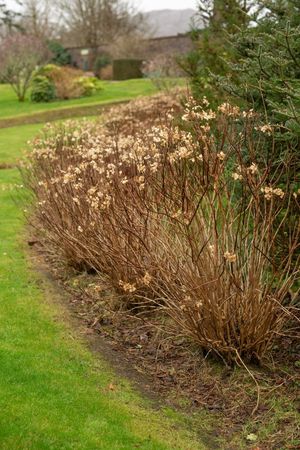 In autumn, hydrangea flowers often develop beautiful colours and remain decorative well into winter. Had enough of the faded brown flower heads? You can remove them now. Do take care where you cut: on mophead hydrangeas (Hydrangea macrophylla), the new flower buds sit just below the old blooms. Always prune just above the highest healthy bud.
Some general pruning guidelines for hydrangeas: Hydrangea arborescens, H. aspera and H. paniculata can be pruned back hard in spring. Each year, cut all stems back in early spring to just above ground level, or leave a few older branches and shorten them to around 30 cm. These hydrangeas will flower again in the same year. Climbing hydrangea (H. anomala ssp. petiolaris) can be pruned after flowering. Mophead hydrangea (H. macrophylla), mountain hydrangea (H. serrata) and oakleaf hydrangea (H. quercifolia) do not necessarily need pruning.
Tip for hydrangeas: how to rejuvenate a hydrangea
Old, overcrowded shrubs of Hydrangea macrophylla, H. serrata and H. quercifolia can be rejuvenated through pruning. Remove a few of the oldest stems completely, cutting them back to ground level. Prune several healthy stems slightly higher, just above an outward-facing bud. Leave a number of young shoots untouched. In the end, you will have a limited number of well-spaced stems. Pruned branches will not flower this year, but usually bloom again the following season.
Compost
Making your own compost saves space in your household waste bin and provides excellent nourishment for garden soil. Do you have a small unused corner? Consider starting a compost heap. Compost containers can be made from wire mesh or wood, while plastic models are also widely available. Place some branches at the bottom and regularly add garden waste and kitchen scraps, preferably finely chopped. Avoid adding large amounts of a single material, as this slows decomposition. Composting can be accelerated with a compost activator. During warm periods, prevent the heap from drying out by watering it occasionally. After around six months, the compost is ready to use and does not need turning. Sieving is optional; coarse material can be reused as a base for the next heap.
Training fruit trees
A freely growing fruit tree with a tall trunk is undeniably beautiful, but not everyone has the space. Often there is a sunny wall or fence that lends itself perfectly to training a fruit tree. A large pot or container can also be suitable. With consistent pruning and tying in, you can create a well-shaped espalier apple or pear tree yourself. There are many forms to choose from, ranging from single-stem cordons to U-shaped palmettes and fan-trained trees. Pre-trained trees are available, but starting with a young tree is equally rewarding. Shaping a tree yourself through careful pruning gives great satisfaction.
February tip: bringing branches into bloom
Early-flowering shrubs are waiting for spring to open their buds. However, if you place a few branches indoors in a warm room, they become confused and bloom earlier. Try this with branches of cornelian cherry (Cornus mas), winter hazel (Corylopsis), hazel (Corylus avellana), forsythia, magnolia and flowering almond (Prunus triloba).
Plants that look beautiful in February
- Cornelian cherry, Cornus mas
- Dogwood, Cornus sanguinea ‘Midwinter Fire’
- Daphne, Daphne ‘Perfume Princess’
- Paper bush, Edgeworthia chrysantha
- Winterheath, Erica darleyensis
- Spring snowflake, Leucojum vernum
- Goat willow, Salix caprea
- Sweet violet, Viola odorata
February gardening jobs
Planting and sowing
- order summer-flowering bulbs
- sow the first vegetables and annuals indoors
- plant shallots in the vegetable garden
- plant deciduous trees, shrubs and hedges if the ground is not frozen
Pruning, cutting and training
- prune wisteria
- prune kiwi vines
- prune climbing roses
- trim ivy-covered walls
- complete winter pruning of fruit trees, roof-trained trees and espaliers
Feeding and mulching
- spread compost over borders
- top up mulch layers
Miscellaneous
- remove weeds where possible
- if frost is expected, protect tender plants with reed mats or bubble wrap
- consider what you can do this season to support biodiversity in your garden
Text: Modeste Herwig